Flat Roofing Contractor Serving Oceanside, NY
Low-slope roofs near open water rarely tear apart in the middle. Wind catches an unsecured edge, lifts the perimeter, and works inward from there until a whole section is gone by morning. Edge metal and fastening pattern decide whether that happens. Roofing Freeport is GAF Master Elite certified, licensed and insured, with a free estimate.
-
26+ Years of Roofing Experience
-
Licensed and Insured
-
GAF Master Elite Certified
-
50-Year Transferable Warranty
Flat Roofing SERVICES
Flat Roofing Work We Handle in Oceanside
Flat roof installation
Flat roof repair
TPO membrane roofing
EPDM rubber roofing
Low-slope addition roofing
Commercial low-slope roofing
Where a Bay-Side Flat Roof Starts Failing
Check the perimeter before you check anything else. The first three feet of a low-slope roof carry far more uplift pressure than the field does, and corners carry more still. What looks like cosmetic movement at an edge is usually the opening act.
- Drip edge or fascia metal loose, rattling, or visibly lifted at a corner
- Membrane fluttering or rippling across the field on a windy afternoon
- Coping caps shifted, gapped, or missing fasteners along a parapet top
- Termination bar pulling away from a sidewall or chimney flashing
- Seams opened at a lap within a few feet of the roof edge
- Gravel or ballast scoured away from corners and pushed into piles
Fully Adhered TPO Systems
The membrane bonds to the insulation across its entire surface, which is why we default to it on canal-facing streets in south Oceanside where wind gets an unobstructed run at the roof.
Mechanically Attached Membranes
Fastened on a calculated pattern through the deck, a sound and economical choice on sheltered rear additions set back from the water on Oceanside’s interior blocks.
Reinforced Elevated Deck Roofing
Built for the raised porches, breezeways, and entry decks that came out of post-Sandy rebuilding, where the roof plane now sits higher and takes considerably more exposure.
The Edge Does the Structural Work
Roofing industry standards treat perimeter edge securement as a structural component rather than trim, and coastal exposure is exactly why. We fasten edge metal on a tighter schedule than the field requires, increase fastener density through corner and perimeter zones where uplift pressure concentrates, and terminate the membrane mechanically at every wall and curb instead of relying on adhesive alone to hold a vertical leg. Coping gets cleated and lapped so wind cannot get a finger under it.
What Shapes Flat Roofing Cost
Two identical square footages in Oceanside can price differently, and the reason is usually the perimeter and the deck rather than the sheet itself.
Attachment method the exposure calls for
Fully adhered systems cost more in labor and adhesive than a mechanically attached layout, and the closer a property sits to open water, the harder that upgrade is to responsibly skip.
Linear footage of edge and parapet
Edge metal, coping, cleats, and termination bars are priced by the running foot. A roof with many corners and wall transitions carries far more perimeter than its area suggests.
Deck condition and fastener holding
Older plank or thin plywood decks sometimes will not hold fasteners at the density the exposure requires, which means deck work or a switch in attachment approach before anything goes down.
Height and staging on elevated homes
Post-Sandy elevation raised many Oceanside roof planes well above their original height, and the extra staging, hoisting, and safety setup adds real hours to the job.
Get a Free Estimate
Every Oceanside property owner receives a free, no-obligation flat roofing estimate from our GAF Master Elite team. The attachment method, edge detail, and fastener spec all appear in writing so nothing is left to interpretation later.
From Lifted Edge to Sealed Roof
Describe the Damage
Call our Freeport office and tell us what moved, where it moved, and whether it happened after a specific storm.
Book the Site Visit
We arrive from Freeport headquarters, roughly 3.5 miles and about ten minutes from most Oceanside addresses, and assess the deck and perimeter.
Deck Prep and Membrane
We prepare the substrate, set insulation, then attach the membrane on the pattern your exposure zone calls for.
Perimeter Detail and Sign-Off
Edge metal, coping, and terminations go on last. We walk every corner with you before clearing the property.
Oceanside Properties We Roof Most Often
- Canal-front homeowners whose flat additions take direct, unobstructed wind
- Owners of raised porch and breezeway roofs built during post-Sandy elevation work
- Retail and service buildings along the Long Beach Road business corridor
- Homeowners near Earle Naval Weapons Station Park with exposed flat rear extensions
- Landlords maintaining low-slope roofs on multi-unit buildings across town
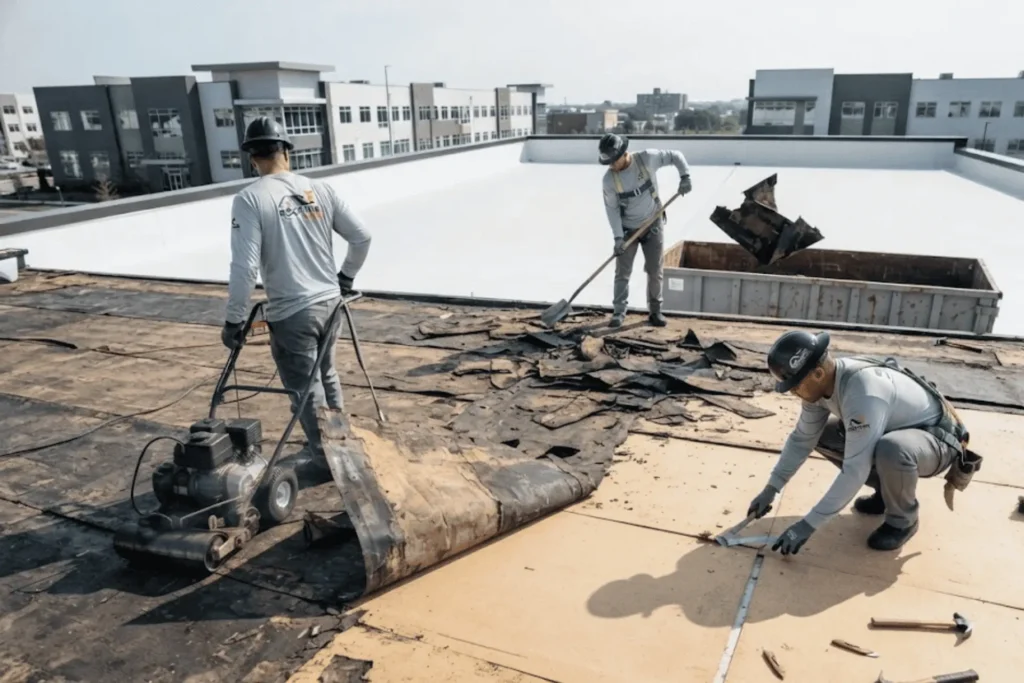
What a Properly Secured Flat Roof Delivers
Get the perimeter right and the rest of the roof rarely makes the news. Get it wrong and the field membrane never gets the chance to prove itself.
It Stays Put in a Nor'easter
A correctly fastened edge removes the entry point wind needs before it can peel anything inward.
Space You Can Actually Use
Condensers, vents, and service access all live on a low-slope roof in a way a pitched roof cannot allow.
Repairs Stay Local
A damaged area gets cut out and welded or taped back without disturbing the surrounding field.
Documented Wind Spec
Your fastener pattern and edge detail are written down, which matters when a carrier asks questions later.
frequently asked questions
What Oceanside homeowners and building owners ask us most about low-slope roofing.
Why does the edge of my flat roof keep lifting?
Perimeter zones carry substantially higher uplift pressure than the middle of a roof, and corners carry more than perimeters. If edge metal was fastened on the same schedule as the field, wind eventually finds the weakest point, gets underneath, and starts working the membrane loose from there.
Is fully adhered worth the extra cost near the canals?
On directly exposed properties, generally yes. A bonded membrane spreads wind pressure across the whole assembly instead of concentrating it at fastener rows. On sheltered interior blocks, a properly engineered mechanically attached system performs well and costs meaningfully less to install.
Can a flat roof handle the wind on an elevated home?
Yes, provided the specification accounts for the added height. Raising a house also raises its roof into faster airflow, so we increase perimeter fastening and detail the edge for that exposure rather than reusing a spec written for the original ground-level roofline.
How long should a low-slope membrane last here?
Expect a properly installed single ply system to give solid service for decades, though salt air, ultraviolet exposure, and foot traffic all influence the outcome. Perimeter details usually need attention before the field membrane does, which is why we recommend a look after any major storm.
Do you repair flat roofs or only replace them?
We repair whenever the assembly is worth saving. Re-securing lifted edge metal, replacing coping fasteners, and welding open seams are all sensible fixes on a roof that is otherwise sound. Replacement gets recommended when the deck or insulation beneath has failed.
Meet All Our Services


Get Your Perimeter Looked At Before Winter
If your edge metal rattles, your membrane ripples, or something shifted after the last storm, that is where the next failure starts. We will assess the deck, the perimeter, and your actual wind exposure, then put the spec in writing. Free estimate, no obligation.